
In today’s primary classroom, we’re not just teaching sums and spellings; we’re nurturing the whole child. This includes their emotional intelligence and their ability to navigate the complexities of the modern world. One area that often gets overlooked, yet profoundly impacts wellbeing, is financial wellbeing.
Money isn’t just about numbers; it’s deeply intertwined with our feelings, our sense of security, and our future aspirations. For primary students (KS1 & KS2), understanding this connection is crucial for building resilience and a healthy relationship with money. At The Financial Fairy Tales, we believe that integrating financial wellbeing into the PSHE curriculum can be both engaging and transformative.
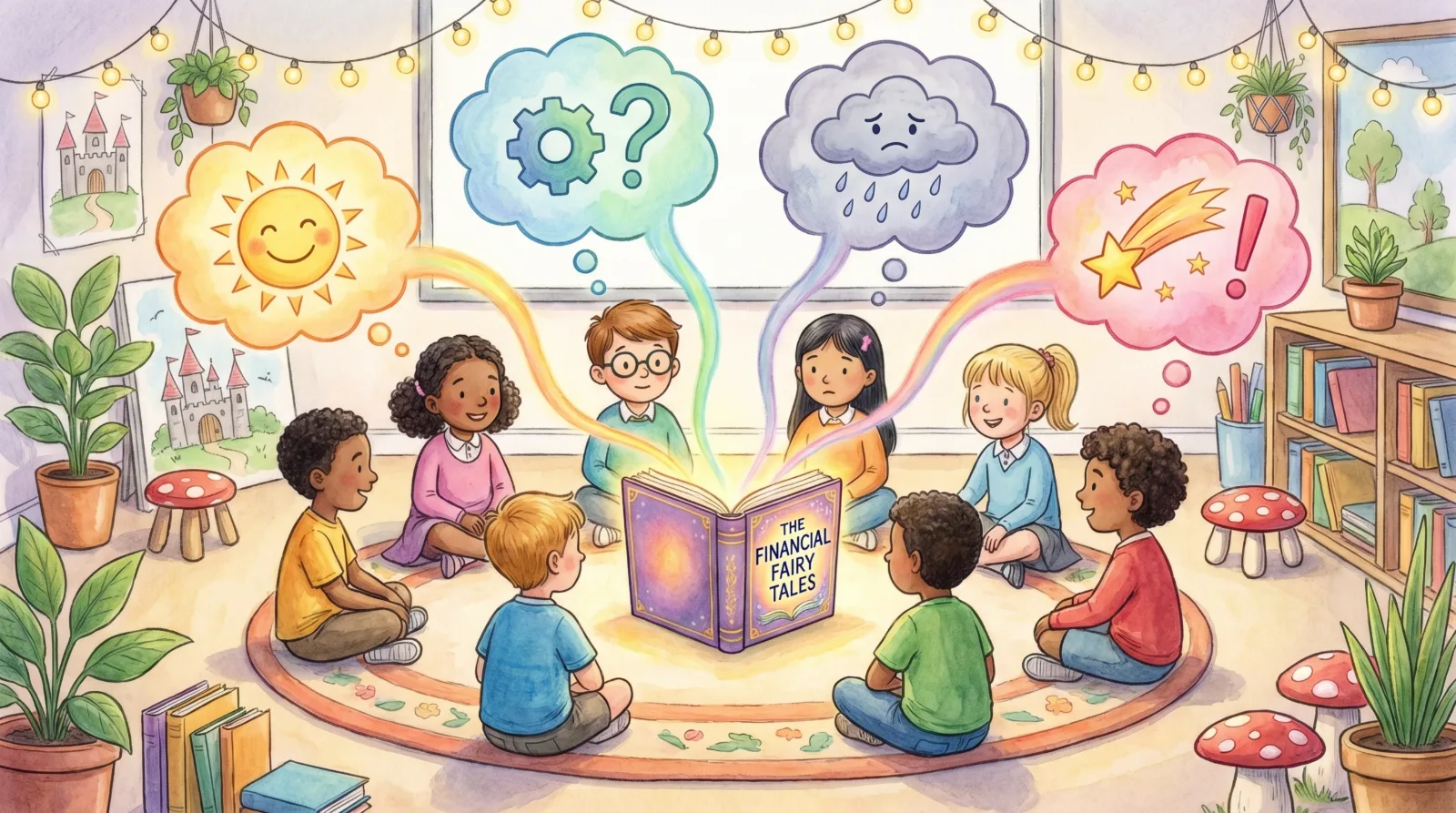
Why Financial Wellbeing Matters for Young Minds
Children are incredibly perceptive. They pick up on adult anxieties about money, hear conversations about rising costs, and see the impact of financial decisions all around them. Teaching financial wellbeing means:
1.Reducing Anxiety: Giving children the language and tools to understand money can demystify it, reducing potential stress.
2.Building Resilience: Learning to manage small financial setbacks (like spending all their pocket money too soon) builds coping mechanisms for bigger challenges later.
3.Fostering Empathy: Understanding that money can be used to help others (the ‘Give’ jar) cultivates compassion and a sense of community.
4.Connecting to Purpose: When children see money as a tool to achieve their dreams and contribute positively, it gives their financial learning a deeper meaning.
Classroom Activities for KS1 & KS2
•The ‘Money Emotions’ Chart (KS1): Create a chart with different emotions (happy, worried, excited, calm). Discuss scenarios where money might evoke these feelings (e.g., saving for a toy, losing a coin, giving to charity). This helps children articulate their feelings about money.
•’Dream Jar’ Visualisation (KS2): Link to our Dreams Can Come True story. Have students draw or write about a personal dream and a community dream. Discuss how money (or other resources) can help achieve these. This connects saving to purpose.
•’What Would You Do?’ Scenarios (KS1 & KS2): Present simple dilemmas: “You found £1. What would you do?” or “Your friend is sad because they can’t afford a treat. What could you do?” These discussions encourage ethical thinking and problem-solving.
Aligning with the PSHE Curriculum
The PSHE curriculum for primary schools often covers themes of managing feelings, making choices, and understanding the wider world. Financial wellbeing fits perfectly within these objectives, providing practical contexts for abstract concepts. By using stories and relatable examples, educators can make these lessons stick.
At The Financial Fairy Tales, our books and activity guides are designed to be a seamless fit for these discussions, offering narratives that explore resilience, purpose, and the emotional landscape of money. It’s about empowering children to feel confident and capable, not just with numbers, but with their entire financial future.
Ready to bring financial wellbeing into your classroom? Explore our Financial Fairy Tales series on Amazon and discover resources that support a holistic approach to education.
I love how the blog connects money to emotions and resilience—this is something I think gets overlooked in most educational approaches. As someone who builds tools for accessing online video content, I’m always thinking about how visual storytelling can make abstract concepts more tangible for kids. The idea of weaving financial literacy into the PSHE curriculum feels long overdue. Looking forward to exploring more of these ideas.
I love how you frame financial wellbeing as something that starts with emotions rather than numbers. That resonates with how we’re seeing AI tools reshape learning too — it’s not about the tool itself but how it makes people feel capable and curious. Would be fascinating to see how AI-powered storytelling platforms could reinforce that money-emotions connection you described. Thanks for sharing this thoughtful approach to PSHE.
The point about connecting money to emotions rather than just numbers really resonates. At Cycle AI, we see the same principle at work in how young people form relationships with technology. If we teach children to see money as tied to their feelings, security, and aspirations from an early age, we’re setting them up with emotional resilience that extends far beyond financial literacy alone. Looking forward to more ideas from your work with primary classrooms!
The point about connecting money to emotions really resonates — I think that framing helps dismantle the “money doesn’t grow on trees” mindset before it takes root. Linking financial literacy to PSHE goals feels like a practical way to make it stick in the classroom.
I appreciate how this post connects emotions to financial choices from an early age. When children ask parents to download music or videos, those moments can quietly teach them about mindful spending and distinguishing between wants and needs. A simple conversation at the app store can become a practical money lesson without dampening the joy of entertainment.
Love the point about connecting money to emotions and purpose rather than just numbers — that’s something kids rarely get taught explicitly. It reminds me how much children absorb from the media and platforms they use every day, often without any guidance on what they’re really seeing. Do you think educators could use that same emotional framing when discussing in-app purchases or content creator culture with older KS2 students? Would love to see how the ‘want list’ technique from another post here might tie into that broader media literacy angle.
I love the idea of connecting money lessons to emotions rather than just numbers — that “want list” technique especially feels like something that could actually stick with kids. It reminds me how important it is for educators to have easy access to resources, and I’ve found that having tools to download and keep educational videos offline makes it so much easier to prepare lessons without worrying about internet connectivity. Thanks for sharing these practical scripts; the clarity they offer is exactly what busy teachers need.
Really enjoyed this perspective on connecting money to emotions in the classroom. The point about building resilience and a healthy relationship with money from an early age resonates deeply with how we think about play — games offer a low-stakes way for children to practice decision-making and learn from consequences without real-world pressure. It’s encouraging to see educators tackling financial wellbeing this thoughtfully. Looking forward to more posts on this topic!
The point about avoiding accidental money lessons really resonated. I’ve been thinking about how free, quality resources level the playing field for families who can’t afford premium subscriptions. When every household can access ad-free content without a monthly bill, it removes one more source of financial stress. Tools like Muka Live show it’s possible to offer premium experiences at zero cost.
Really enjoyed this piece. The idea of linking money to feelings from an early age resonates deeply with the broader goal of making financial education stick. Glad to see content like this reaching educators and parents — it’s exactly the kind of mindset shift that creates lasting impact.
Great point about connecting money to emotions in the classroom. As a teacher myself, I find YouTube is invaluable for finding quality financial literacy videos for KS1/KS2 students, but streaming reliability varies. Tools like Muka Saver Net let me download educational content in advance so I’m not dependent on classroom Wi-Fi holding up during a lesson. Has anyone else found offline video access helpful for PSHE sessions?
Roundup blogs promising twenty fresh codes this week are padded with leftovers from completely different Roblox titles. Checking stand out roblox wiki cuts through that noise by keeping only the 4 real active strings, 50KLIKES, HUGE100K, RELEASE, and THANKYOUHUGERELEASETHANKS, while keeping expired PLAYTEST separated. Those extra lines on copycat sites usually come from World of Stands or A Bizarre Run strings like WELOVEABRTESTING and D4C, or broken translations like ENORME100K and LIBERAR. Stick to the four verified codes in exact uppercase on a newly opened public lobby so every valid entry registers cleanly without wasting resets.
The ‘Money Emotions’ chart for KS1 is a genuinely practical idea — getting children to name feelings like worried or calm around money seems far more useful than just drilling coin recognition. Connecting saving to something like a ‘Dream Jar’ also gives the numbers a purpose, much like the simple visual tracking you get with Krillion Unlimited .