
“Can I have some money?” is one of the first money conversations every parent has. “How could you earn some?” is the one that changes everything.
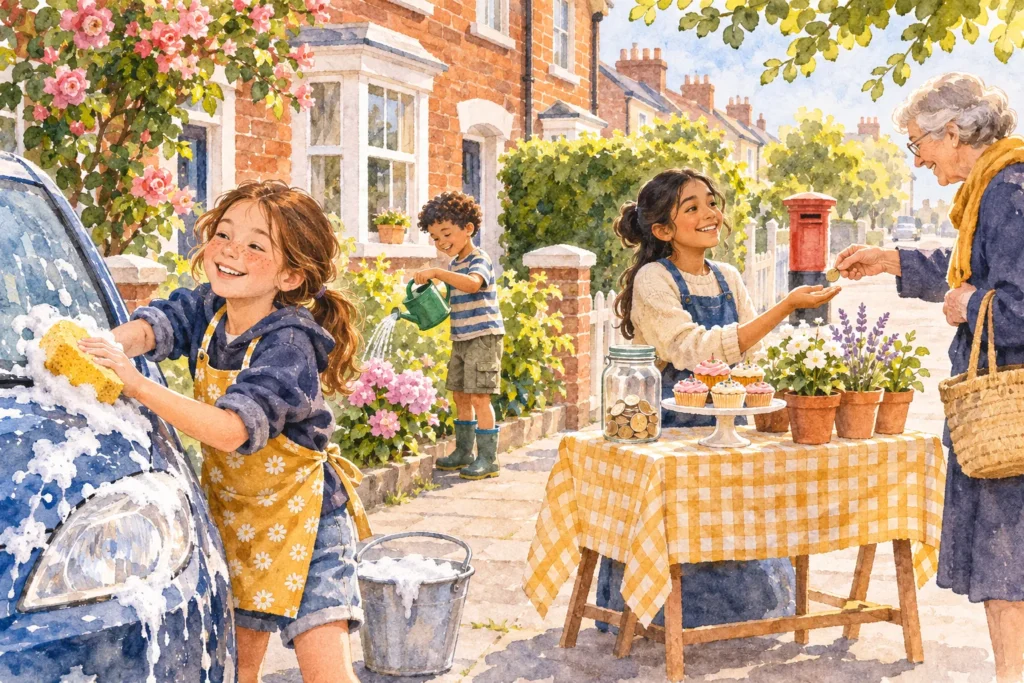
When I first looked at the latest UK pocket money figures, one number jumped out. The average child gets £3.94 a week in regular pocket money, but £9.74 a week once you add the money they earn from chores and jobs. By the teenage years, most of a child’s money is earned, not given. That’s not a problem to solve. It’s an opportunity.
A first job, even if it’s washing the family car, teaches something no lecture ever will: money is a reward for creating value for someone else. Here are 30 ways children can earn money in the UK, grouped by age, with what each one pays and what it teaches.
Jobs for kids by age: the quick guide
| Age | Good first jobs | Typical pay | What they learn |
|---|---|---|---|
| 5–7 | Small jobs at home: feeding pets, tidying, helping in the garden | 20p–£1 a job | Effort leads to reward |
| 8–10 | Washing the car, weeding, first “customers” in the family | £1–£3.50 a job | Doing a job properly, being paid fairly |
| 11–12 | Mini-enterprises: car boot stall, crafts, baking, plant sales | Varies: profit, not wages | Costs, prices and profit |
| 13–15 | Paper round, helping in a shop or café, pet sitting | Agreed hourly rate | Reliability, turning up on time |
| 16+ | Part-time job, babysitting, tutoring younger children | Hourly rate | Payslips, tax and budgeting a real wage |
What do chores actually pay in 2026?
Two big UK surveys give us a good benchmark. NatWest Rooster Money’s 2026 Pocket Money Index tracks what children are actually paid per job. Outdoor work pays best by a long way:
| Chore | Average pay per job |
|---|---|
| Mowing the lawn | £3.52 |
| Washing the car | £3.36 |
| Cleaning the windows | £1.65 |
| Gardening | £1.38 |
| Walking the dog | £1.15 |
| Looking after chickens | £1.14 |
| Making the bed | 28p |
Confused.com’s 2026 survey of parents found something similar, with cleaning the car the best-paid task at £3.66 on average, followed by gardening (£3.57) and helping with younger siblings (£3.52). It also found that three-quarters of parents now link at least some pocket money to chores.
Notice the pattern: the jobs that pay most are the ones that genuinely save an adult time or money. That’s exactly how the grown-up world works too.
Ages 5–7: first jobs at home
At this age, the amount matters far less than the connection. “I did a job, I got paid” is a powerful idea for a five-year-old. Keep jobs short, pay straight away, and pay in coins they can hold and count.
- Feeding the pets. A daily job with a living, breathing reason to do it well.
- Watering plants indoors or in the garden.
- Pairing socks from the clean washing. Surprisingly satisfying, and good for counting.
- Laying the table for family meals.
- Tidying the toy box or a shared space (their own room is best left as an everyday expectation).
- Helping in the garden: collecting leaves, pulling easy weeds, carrying the trug.
Ages 8–10: bigger jobs and first customers
Now children can do a job properly, and that’s the lesson: if you’re being paid, the job has to be done well. This is a lovely age to introduce the idea of a “customer”, usually a grandparent or a friendly neighbour, with you close by.
- Washing the family car, one of the best-paid chores in the UK.
- Weeding a flower bed or patio.
- Washing the windows (inside, or ground floor only).
- Walking the dog with an adult, or a neighbour’s dog with permission.
- Washing a grandparent’s car: their first paying customer outside the home.
- Sorting the recycling and putting the bins out.
- Selling unwanted toys at a car boot sale, with you running the stall together. Here’s our guide to a car boot sale with kids.
Ages 11–12: mini-enterprises
This is where things get exciting. Instead of being paid for a job, children can start a tiny business and keep the profit. They’ll quickly discover that you have to spend money to make money, that price matters, and that not every idea works first time. All brilliant lessons. It’s the same journey the characters take in The Magic Magpie.
- A bake sale at a school fair or community event.
- Selling handmade crafts: bracelets, cards, bookmarks.
- Growing and selling plants from cuttings or seeds.
- A car-washing round for neighbours, with a parent agreeing the street and the prices.
- Running their own car boot stall, from pricing to counting the takings.
- A lemonade or cake stand at a family event.
- Helping a neighbour with their garden, with you knowing who and where.
For more ideas, see summer side hustle ideas for kids and raising a young entrepreneur.
Ages 13–15: a first real job
At 13, children in the UK can take on light part-time work, within strict limits (see the rules below). A first job outside the family teaches the things school can’t: turning up on time, being polite to customers, and the feeling of a pay packet you earned yourself.
- A paper round, the classic first job.
- Delivering leaflets for local businesses.
- Helping in a shop, stacking shelves or on the till with supervision.
- Light work in a café at weekends.
- Pet sitting for neighbours on holiday.
- Washing cars by hand in your street.
Ages 16+: building real independence
- Babysitting for families they know.
- Tutoring younger children in a subject they’re good at.
- A Saturday job in retail or hospitality.
- Coaching or helping at a sports club they already belong to.
This is also the moment to talk about payslips, tax and budgeting a real wage. Our financial independence guide for teens is a good place to start.
Can my child legally get a job? The UK rules at a glance
Helping out at home or doing odd jobs for family isn’t “employment”. But once a business employs your child, the law steps in. In England, the key rules for children of school age are:
- Minimum age 13 for part-time work (younger children can only work in areas like performing, under separate rules).
- Never during school hours, and only between 7am and 7pm.
- Term time: no more than 12 hours a week, including a maximum of 2 hours on school days and Sundays.
- Saturdays: up to 5 hours for 13–14 year olds, up to 8 hours for 15–16 year olds.
- School holidays: up to 25 hours a week for 13–14 year olds, 35 hours for 15–16 year olds, with a 1-hour break after 4 hours’ work.
- A 2-week break from work during the school holidays each year.
- A work permit: the employer must register your child with the local council.
- No minimum wage until they leave compulsory schooling (the last Friday in June of Year 11).
Councils set some of the detail locally, including which jobs are allowed, so check your own council’s “child employment” page or GOV.UK’s guide to child employment before your child starts. Rules in Scotland, Wales and Northern Ireland are similar but not identical.
Pocket money or paid jobs? Why not both
I’m a fan of a hybrid approach. A small, regular amount of pocket money teaches children to manage money. Paid jobs on top teach them how money is earned. Everyday tasks, like tidying their room or clearing their plate, stay unpaid, because that’s simply what families do for each other.
If you’re weighing this up, our post on whether you should pay kids for chores goes into more detail.
What should they do with the money?
Earning is only half the lesson. The other half is deciding what to do with it. The simplest system I know is three jars: one to spend, one to save and one to share. A child who earns £3.36 washing the car and puts £1 in each jar has just learnt more about money than many adults ever do. Here’s how to set up the three jars.
Jobs for kids: FAQs
What is the youngest age a child can get a job in the UK?
13, for light part-time work, with limits on hours and a council work permit. Younger children can earn by doing jobs at home or for family and friends, and in some areas such as performing under separate rules.
Can a 13-year-old work in a shop?
Often yes, as long as it’s light work, outside school hours and within the legal hours, and the shop has registered them with the council. Your local council’s rules decide exactly which jobs are allowed.
How much should I pay my child for chores?
UK averages range from 28p for making the bed to £3.52 for mowing the lawn (NatWest Rooster Money, 2026). A good rule of thumb is to pay more for jobs that genuinely save you time, and keep everyday tasks unpaid.
Should children save the money they earn?
Some of it, yes, but let them spend some too. Children learn as much from a purchase they regret as from one they saved for. Splitting earnings between spend, save and share jars is a simple habit that lasts.
Sources: NatWest Rooster Money Pocket Money Index 2026; Confused.com Pocket Money Index 2026; GOV.UK and local council child employment guidance.
Read next: UK pocket money by age 2026, and how to raise an entrepreneurial child.