
Long before a child can count coins, they are reading you. The sigh when a bill arrives. The quick change of subject when money comes up. The relief on your face at the end of the month, or the tension. Children are extraordinary observers of the people they love, and money is one of the things they watch most closely, precisely because we so often go quiet about it.
We tend to think money lessons are things we sit down and teach. In truth, most of what a child learns about money they catch rather than get taught. They pick it up from the everyday, in the ordinary moments we barely notice ourselves.
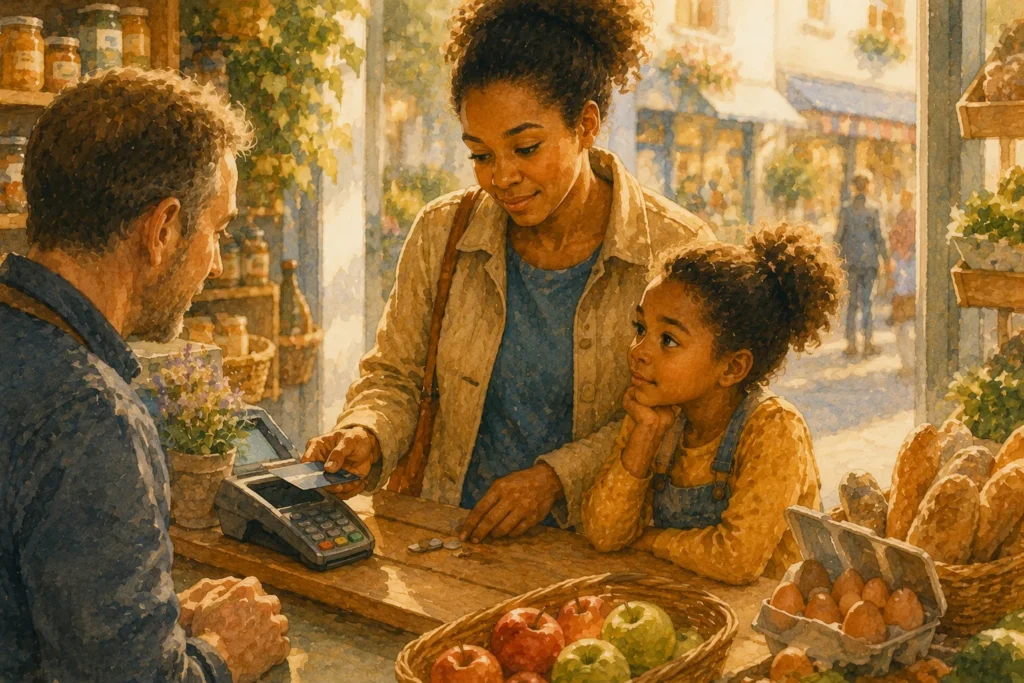
What they are actually learning
When you pause at the shelf and say, “Not this week, we will save for it,” your child learns that waiting is normal and survivable. When you talk about a treat with pleasure rather than guilt, they learn that spending can be joyful and chosen. When you handle an unexpected cost without the house falling into panic, they learn that money problems can be faced calmly.
The reverse is also true, and it is worth being honest about. If money is only ever mentioned through gritted teeth, or as something to worry about, or as a topic that ends conversations, children absorb that as well. Not the details, but the feeling. And the feeling tends to stick.
You do not have to be an expert
Here is the reassuring part. Your child does not need you to have money all figured out. They are not learning your bank balance. They are learning your relationship with money, the mood and the habits, and those you can shape, whatever your circumstances.
A family on a tight budget can raise a wonderfully money-confident child, because confidence does not come from having plenty. It comes from seeing money handled with clarity and calm. Talking openly, making choices out loud, and treating money as an ordinary tool rather than a taboo or a threat.
Small moments that do the heavy lifting
You do not need a curriculum. You need to let your child in on the running commentary of family money.
Let them see you check a price and decide. Let them hear you say no to something you would like, and why. Let them watch you save up for a family treat and feel the pleasure when it finally arrives. Let them see you give, whether to a charity tin or a birthday collection, so that generosity looks like a normal part of having money.
These are not lessons that need setting up. They are already happening. The only question is whether you let your child see them.
Turning the mirror to your advantage
Once you notice that your child is watching, something useful happens. You start to catch your own money language. Many of us are carrying phrases we absorbed as children, sayings like “money doesn’t grow on trees” or “we can’t afford it,” that were handed to us without much thought and shaped how we felt about money for decades.
You get to choose what you hand on. Not by pretending money is endless, but by swapping the anxious phrases for calmer, truer ones. “We are choosing to spend on this, not that.” “That is not in the plan this month.” “Let’s save for it and enjoy it when it comes.” Same honesty, very different feeling underneath.
A gentle place to start
Pick one ordinary money moment this week and simply say a little more of it out loud. The weekly shop, a bill, a treat, a decision to wait. Let your child hear the thinking, in a calm and matter-of-fact voice.
You will not always get it right, and you do not need to. Children are watching the whole picture, not scoring individual moments. What they take away is the overall mood: is money something we face together, with clarity and calm, or something we fear and fall silent about?
You are already teaching your child about money. You have been all along. The lovely news is that you get to decide what the lesson is.